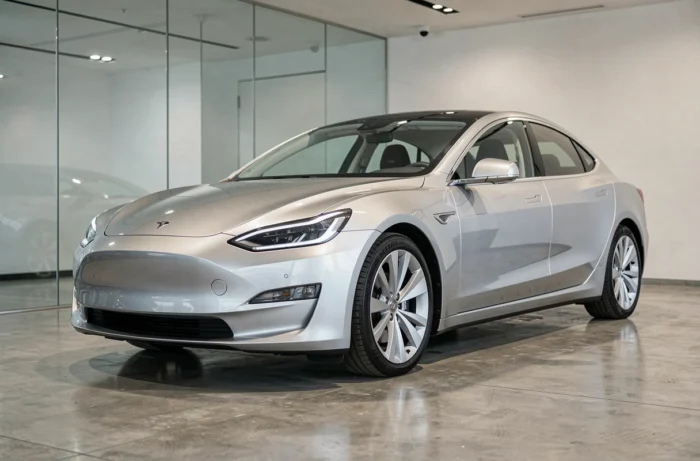
Cars sold today come equipped with technologies that didn’t exist three years ago. Over-the-air software updates, batteries with fundamentally different chemistries, and European regulations requiring new traceability standards: automotive news points to an industry where vehicles are evolving far beyond their powertrains.
Digital battery passports: a regulatory requirement that changes the game
Have you ever scanned a QR code on a food product to find out where it came from? The same principle will apply to electric vehicle batteries. From February 18, 2027, every battery placed on the European market must have a digital passport accessible via QR code. Set out in Regulation (EU) 2023/1542, this system will organize information on each battery’s chemical composition, capacity, carbon footprint, and life cycle.
In practical terms, a used-car buyer will be able to check the battery’s actual condition before signing. A recycler will know which materials to recover. This isn’t a marketing label; it’s a legal requirement with a specific deadline.
However, the timeline for tracing raw materials (cobalt, lithium, nickel) has been pushed back by Regulation (EU) 2025/1561. Manufacturers therefore have more time to map their supply chains. You can keep up with these regulatory changes as they unfold on the L’Actu Auto website, which reports industry announcements as they are published.
Software-defined vehicles: how cars evolve after purchase
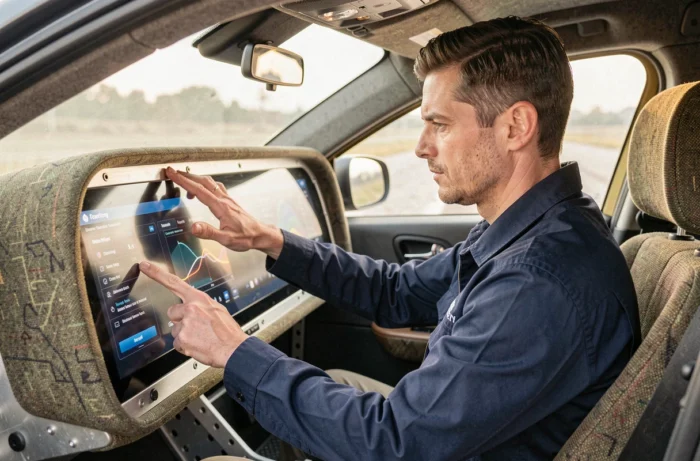
Until recently, a car remained fixed in the version delivered to its owner. Today, several manufacturers offer over-the-air software updates that change how a vehicle performs after purchase. The principle is similar to that of a smartphone: the operating system receives patches, performance improvements, or new features without a trip to the dealership.
This model is transforming the relationship between drivers and their cars. One practical example is adjusting battery management algorithms to improve an electric vehicle’s real-world range several months after it enters service. Driver-assistance systems can also become more precise using data collected across the entire fleet.
What this means for drivers
A car is no longer a finished product but an evolving service. This also represents a paradigm shift for the used-car market: a three-year-old vehicle can have features that didn’t exist when it left the factory.
The downside is dependence on the manufacturer. If the software provider decides to stop supporting a model, its connected features may deteriorate. In Europe, there is still no clear regulatory framework for the software longevity of vehicles.
Charging infrastructure: the network is growing, but reliability remains a work in progress
The proliferation of electric vehicles would be pointless without accessible charging stations. According to the IEA (Global EV Outlook 2025), the number of public charging points increased in 2024. But growth in the network doesn’t tell the whole story about service quality.
Why the distinction? Because an installed charging point isn’t necessarily a working one. Charger breakdowns, connector incompatibilities, and maintenance times vary considerably from one operator to another. For drivers planning a long journey, network reliability matters just as much as its size.
What to look for when assessing the network
- The actual availability rate of charging stations, which measures the proportion of time a station is operational rather than undergoing maintenance or out of service
- Effective charging power, which is often lower than the advertised rated power, especially in cold weather or when several vehicles are charging at the same time
- Subscription interoperability, meaning the ability to use a single card or app across different operators’ networks
The network’s expansion is good news. But automotive innovation in infrastructure will also need to focus on predictive charger maintenance and transparent, real-time availability data.

Safety and onboard artificial intelligence: what’s changing inside the cabin
Driver-assistance systems increasingly rely on artificial intelligence to interpret the vehicle’s surroundings. Cameras, radar, and sensors feed algorithms that detect pedestrians, anticipate emergency braking, and keep the vehicle in its lane.
The novelty isn’t that these features exist (automatic emergency braking has been mandatory on new models sold in Europe for several years), but that they can learn. Algorithms become more accurate using data collected from the entire fleet. As the number of connected vehicles grows, detection models become more precise.
Driver monitoring and technical limitations
Some vehicles now include cameras pointed at the driver. Their purpose is to detect drowsiness, distraction, or a medical emergency. This trend raises a practical question: how far can a vehicle intervene without the driver’s explicit consent?
Manufacturers’ responses vary. Some limit themselves to audible alerts. Others go as far as reducing speed or activating the hazard lights. Vehicle safety is improving, but the rules governing the use of this data still need to be clarified.
- Drowsiness detection by analyzing eyelid movements and head position
- Distraction alerts when the driver’s gaze leaves the road for longer than a set period
- Possible active intervention in steering or speed, depending on the vehicle’s level of assistance
Automotive trends are converging toward cabins that monitor both the road and their occupants. The challenge in the coming months will be to define clear limits for this monitoring, balancing driver protection with respect for privacy. The 2027 car will stand out not only for its powertrain or range, but also for how it handles these technical and ethical trade-offs in everyday use.