Getting a motorcycle licence after 60 is nothing out of the ordinary. French regulations set no maximum age for obtaining an A1 or A2 licence. The real question, which is rarely discussed, is what type of bike to choose and how you plan to use it.
A road-legal mini bike for adults may seem appealing because it is lightweight and has a low seat, but whether it is right for you depends entirely on what you intend to do with it: ride on the road, practise on private land or ride on a track.
Road-legal mini bikes for adults: road, track or private land
The term “mini bike” covers a wide range of vehicles. Some models are road-legal and registered, while others are strictly for off-road use. This distinction makes all the difference.
On the road, a road-legal mini bike falls into the moped or light motorcycle category, depending on its engine size and power. It must be registered and insured for third-party liability, and you need the appropriate licence (AM, A1 or A2). On private land, no licence or registration is required, but insurance is still strongly recommended to cover personal injury.
Track riding is different again. Circuits set their own access rules, often requiring full protective gear (a one-piece suit, back protector and high-top boots) and sometimes a minimum skill level certified by an instructor. Standard insurance policies generally do not cover riding on a circuit.
Before you choose a road-legal mini bike for adults, be clear about how you intend to use it. A model designed for the track will not have indicators, mirrors or compliant lights. The reverse is also true: a road-going mini bike, with its soft suspension and road tyres, will not handle well on a circuit.
Getting a motorcycle licence after 60: which training should you choose?
The training you need depends on the engine size you are aiming for. The A1 licence, for motorcycles under 125 cc, has no age limit. It requires a theory test (the motorcycle theory test, which is separate from the car theory test) and a practical test after around 20 hours of training at a riding school.
If you have held a category B (car) licence for at least two years, a seven-hour training course is enough to ride a motorcycle or scooter up to 125 cc. This route, often called “125 training”, does not include a final test. It is a good way to get started.
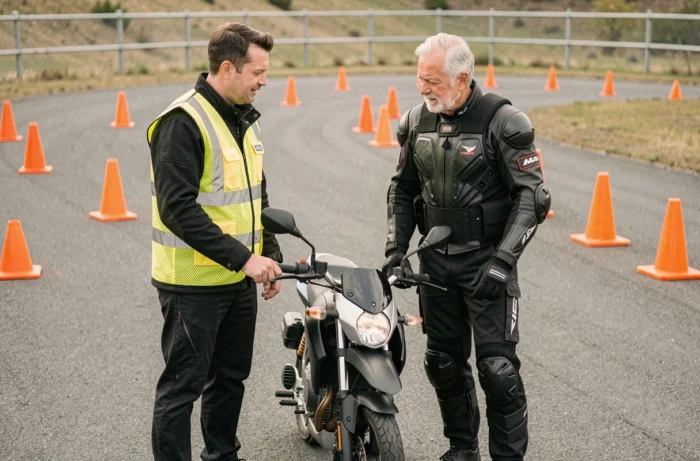
Training at a riding school is still the best investment for anyone starting out later in life. The driving habits you develop in a car do not transfer directly to a motorcycle. Balancing at low speeds, countersteering through corners and using the front and rear brakes separately are all skills you need to learn—and it is best to learn them under supervision.
Physical fitness and medical checks
A medical examination is not legally required to take the standard motorcycle test. However, after 60, seeing a doctor before starting your training is a sensible precaution. Areas to check include visual acuity, shoulder and neck mobility, and reaction time.
Good neck mobility is essential for riding safely, as you need to check to the sides and behind you constantly. If turning your head is uncomfortable, work on this before you even get on the bike.
Gear and insurance: what changes depending on how you ride
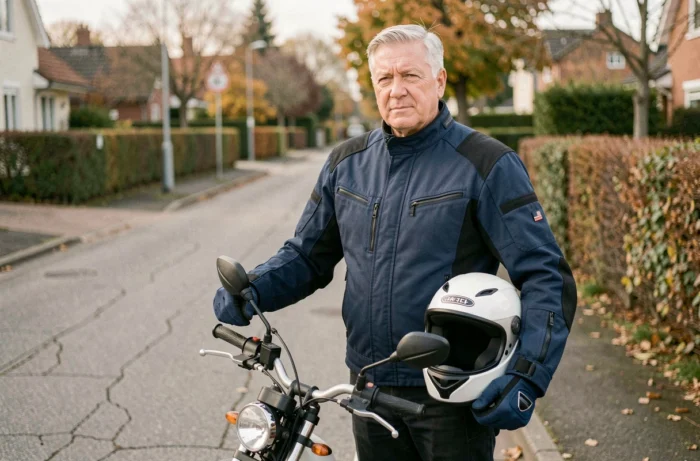
The minimum legal gear for road riding is an approved helmet and CE-certified gloves. In practice, a reinforced jacket, protective trousers and high-top boots can greatly reduce the severity of injuries in a fall.
- On the road: approved helmet and CE-certified gloves are mandatory; a jacket and trousers with protective armour are strongly recommended, as are boots that cover the ankle.
- On private land: a helmet is the minimum; a back protector and joint protection are recommended. There is no legal requirement, but the risk of falling is just as real.
- On a track or circuit: circuit rules often require a one-piece suit, back protector, racing boots, long-cuff gloves and a full-face helmet.
As for insurance, an unapproved mini bike cannot legally be insured for use on public roads. If you have an accident, you will be personally liable for all damages. Always check that your chosen model has European type approval (CE marking or national approval) before taking out a policy.
The real cost of motorcycle insurance for older riders
Insurers consider novice riders to be higher-risk, regardless of age. At 60, with no motorcycle riding history, you will start without a no-claims bonus. Your premium will be higher than that of an experienced rider of the same age, but often lower than that of an 18-year-old, as the accident statistics differ.
Get several quotes and specify the exact engine size and intended use. A policy for “daily commuting” will not cost the same as one for “weekend leisure riding”.
Building your skills safely: your first few months on a mini bike
The first few weeks after getting your licence are the riskiest. Confidence grows faster than actual skill. Start with short, familiar routes and avoid rush hour.
- Begin with a few-kilometre rides on quiet roads, avoiding complex roundabouts and fast roads.
- Gradually increase the length and difficulty of your rides over several weeks.
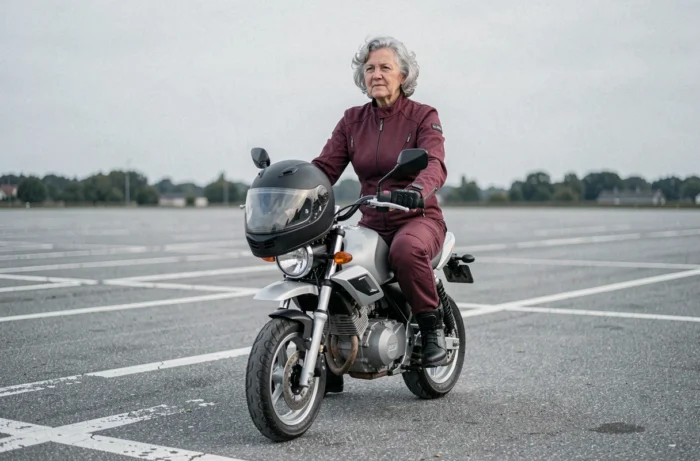
- Practise emergency braking in an empty car park at least once a week during your first month.
- Always wear all your protective gear, even for a five-minute ride.
A mini bike’s light weight is both an advantage and a potential pitfall. It makes manoeuvring at a standstill easier, but its small size makes it less visible in traffic. Wear a high-visibility vest or a light-coloured jacket, especially in urban areas.
After 60, muscle recovery takes longer. Keep your rides to a reasonable length during the first few weeks. Fatigue affects your reflexes well before you consciously notice it. A well-ridden one-hour trip is more beneficial than a three-hour ride where your concentration wanes during the final third.