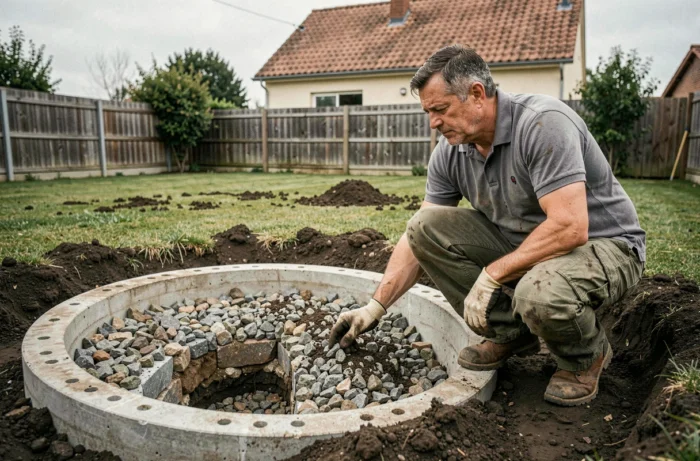
A soakaway is a buried infiltration structure that collects rainwater and gradually releases it into the ground. In France, it is strictly reserved for rainwater, and installation requirements vary from one municipality to another depending on the local urban plan (PLU), stormwater zoning and local drainage regulations.
This variation makes the issue less straightforward than it might seem: a soakaway is not suitable for every site, and it is not always the solution required by the local authority.
Soil permeability and the water table: the two factors that determine everything
Before considering sizing or materials, the first question concerns the ground beneath the site. A soakaway works by infiltration: water passes down through permeable layers to reach the water table. If the soil is clayey or the water table is high, infiltration may be significantly slowed or even impossible.
FRY Études points out that clayey soils and high water tables can limit or prevent infiltration. In these cases, water stagnates in the structure instead of draining away, making it ineffective and potentially causing damp to rise near the foundations.
A percolation test carried out directly on the plot measures how quickly water infiltrates the soil. The results determine which solution to choose: a soakaway, an infiltration trench, a retention basin or a controlled-flow discharge into the drainage network. When assessing the benefits of a soakaway, soil permeability remains the deciding factor between an effective structure and a malfunctioning installation.
Local soakaway regulations: PLU, distances and permits
Regulations are not uniform. Your municipality’s PLU, stormwater zoning and drainage regulations may each impose different requirements. FRY Études notes that connection to the stormwater network is not an automatic right: some municipalities require rainwater to infiltrate on the plot, while others prohibit it in certain areas.
Technical sources commonly cite minimum distances of around three metres from buildings, five metres from property boundaries and thirty-five metres from drinking water abstraction points. These distances may be greater in sensitive areas.
Preliminary checks
- Check the PLU and stormwater zoning with your local town hall to find out which rules apply to your plot
- Confirm whether a works declaration or specific permit is required before excavation
- Have a percolation test carried out to confirm that infiltration is technically feasible on your site
- Make sure the location meets the minimum distances from buildings, boundaries and water abstraction points
Failing to check these requirements in advance can result in penalties and, more practically, a structure that does not do its job.
Sizing for heavy rainfall: an often-overlooked consideration
Most articles about soakaways describe how they perform under normal conditions. Heavy rainfall presents a different challenge. A structure sized for ordinary rainfall can become saturated during a Mediterranean storm, when rainfall totals far exceed seasonal averages.
The design should account for exceptional rainfall scenarios, not just everyday showers. An undersized soakaway will overflow, leaving water on the surface—precisely what it was intended to prevent. The required usable volume depends on the infiltration rate measured during the percolation test, the area draining into the soakaway (roof, patio) and the rainfall intensity used for the calculation.
For plots in at-risk areas, an additional system—such as temporary storage or an overflow to an outlet—may be needed alongside the soakaway.
Alternatives to soakaways: when deep infiltration is not the answer
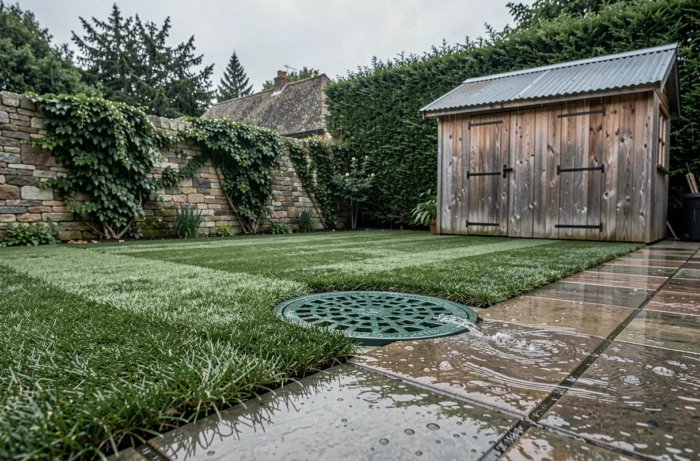
A soakaway is just one of several ways to manage rainwater on a plot. The La Rochelle Urban Community notes that shallow, planted infiltration systems can reduce downstream overflows and support biodiversity. Landscaped swales, rain gardens and tree pits can sometimes serve the same purpose without requiring deep excavation.
The choice between these solutions depends on several factors:
- Soil permeability at the surface and at depth, which can vary across the same plot
- Available ground space: a soakaway takes up little surface area, unlike a swale
- Local drainage requirements, which may specify a particular type of structure or a maximum discharge rate
On a clayey site with a high water table, a storage solution with a controlled discharge into the network is often more suitable than an infiltration structure. A soakaway remains a good option when the ground allows it: permeable soil, a sufficiently low water table and a location set back from buildings.
Soakaway maintenance: what determines its lifespan
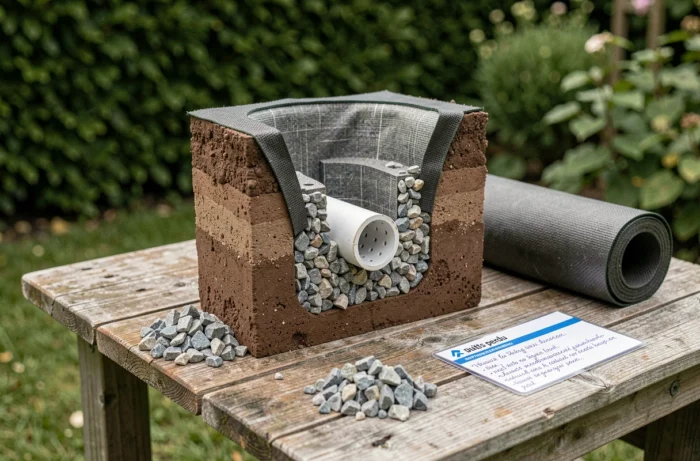
A clogged soakaway no longer works. Leaves, sediment and fine particles carried by the gutters eventually block the geotextile or gravel bed. Without maintenance, infiltration capacity gradually declines until the system becomes completely blocked.
Cleaning the gutters and inspection chambers upstream of the structure is the first line of defence. A silt trap installed between the gutters and the soakaway catches some of the debris before it reaches the infiltration area. Inspecting the soakaway itself at least once a year helps identify early signs of clogging before the problem becomes irreversible.
A properly maintained soakaway can last for decades. A neglected one may last only a few years, potentially requiring excavation work to be redone at a cost far greater than regular maintenance.