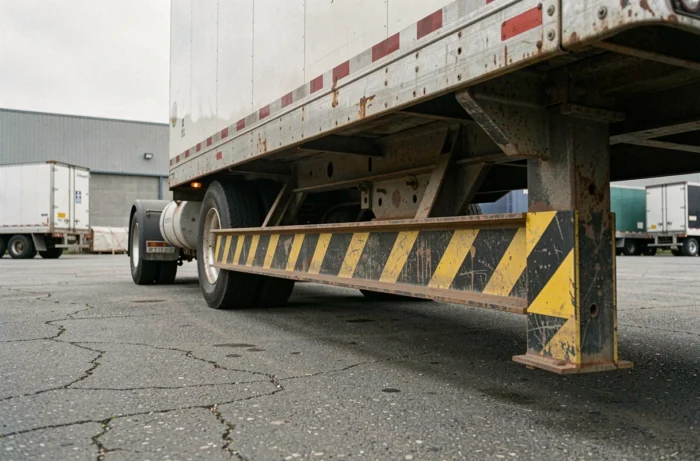
A heavy goods vehicle parked in a rest area, with its tipper body raised and no functional rear underrun protection: all it takes is for a car to approach too fast for the accident to turn fatal. The rear underrun protection device (often called an underrun bar) is the last physical barrier between a truck’s chassis and a car’s passenger compartment. European regulations strictly govern these devices, and recent changes to Regulation R58-03 have updated the requirements for all commercial vehicles.
Regulation R58-03: what has changed for rear underrun protection
UN Regulation R58 has governed rear underrun protection devices on commercial vehicles for several decades. Version R58-03, adopted in November 2015, was introduced in two stages. From 1 September 2019, fitting bars compliant only with the previous R58-02 version was no longer permitted on any new vehicle type. Then, from 1 September 2021, all new vehicle registrations require an R58-03-approved bar.
Between these two dates, extensions of R58-02 type approvals for existing vehicle types were still possible. As a result, vehicles still in service may have bars that comply with the previous standard, which is not an issue as long as the vehicle retains its original type approval. However, any replacement or modification must now comply with R58-03.
To better understand the requirements for truck rear underrun protection, it is also important to distinguish this regulation from other mandatory protective systems: R73 covers side protection, while R93 covers front underrun protection. R58 compliance says nothing about a vehicle’s side protection, and vice versa.
Rear underrun protection bars: practical technical constraints
On paper, a rear underrun protection bar looks like a simple tube attached beneath the chassis. In practice, requirements vary considerably depending on the vehicle type and its intended use.
Vehicles with tipping bodies
Trucks fitted with automatically tipping bodies present a specific challenge: the bar must be able to retract or lift to allow the body to tip. Solutions are available (retractable bars, manually or hydraulically raised), but they add a mechanism that must be maintained and checked regularly. A seized hydraulic cylinder or worn locking system can leave the bar raised while the vehicle is moving, effectively leaving it without rear protection.
Choosing the material and profile
Manufacturer Pommier, for example, offers more than a hundred rear underrun protection bar models in several configurations:
- Fixed or retractable bars (angled or horizontal), suitable for standard semi-trailers and flatbeds
- Manually or hydraulically raised bars, designed for tipping bodies, tail lifts and collection vehicles
- Round or square-section steel or aluminium tubes, depending on the weight requirements and strength of the chassis
Choosing between steel and aluminium is about more than just cost. Aluminium makes the vehicle lighter but is less resistant to repeated impacts than steel, which can be an issue for construction vehicles that frequently reverse during manoeuvres.
Type approval and production conformity: look beyond the product reference
It might seem that buying a bar bearing an R58-03 approval number is enough to ensure compliance. The reality is more nuanced. UN rules on conformity of production require that mass-produced vehicles remain compliant with the approved type. In other words, it is not enough for the bar model to have been approved: the actual unit fitted must match the type described in the technical documentation.
When a vehicle is modified (bodywork replacement, tail lift installation or changes to the rear overhang), the original bar may no longer be suitable. A modified overhang changes the bar’s position relative to the ground and the rear edge of the vehicle. In this case, you must check that the fitted bar remains within the tolerances set out in the regulation, or install a new one suited to the modified configuration.
Vehicle inspections and defective bars
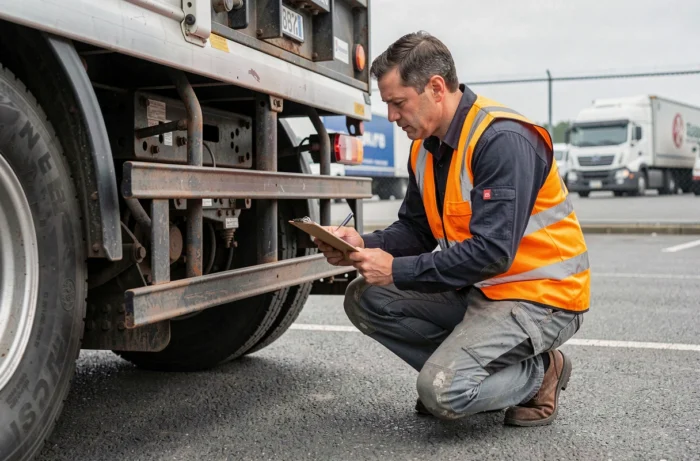
Periodic vehicle inspections are a checkpoint at which the condition of the rear underrun protection bar is assessed. A bent, poorly secured or missing bar will result in a defect being noted and may require a retest. Since heavy goods vehicles are inspected annually, a bar damaged between inspections could remain in service for several months without being detected.
In practice, the bars most often damaged are those on vehicles that frequently manoeuvre around loading bays or construction sites. Low-speed impacts do not always cause visible damage, but they can distort the mounting points and reduce the bar’s ability to absorb impact in a real collision.
Rear, side and front protection: three separate regulations for trucks
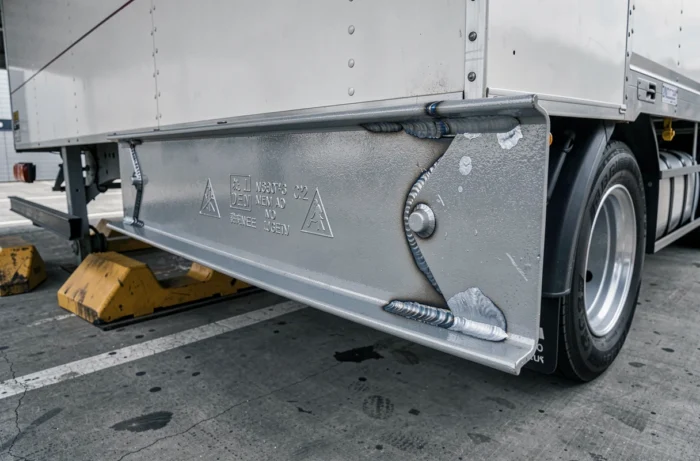
A common mistake is to treat a heavy goods vehicle’s passive safety as a single, uniform system. Rear (R58), side (R73) and front (R93) protection are each governed by a separate regulation, with their own technical requirements.
- R58 (rear protection) aims to prevent a car from underrunning the rear of a truck or trailer
- R73 (side protection) covers devices that prevent pedestrians, cyclists or motorcyclists from passing beneath the side of a vehicle
- R93 (front protection) applies to the front structures of cabs to reduce injuries in collisions with vulnerable road users
When buying a used vehicle or making a modification, checking the documentation for each device separately helps avoid discovering a compliance issue during a vehicle inspection or after an accident.
Rear underrun protection remains the equipment most directly linked to the survival of car occupants in a rear-end collision. Compliance with R58-03, the bar’s actual condition on the vehicle and its suitability for the chassis configuration are not mere administrative details: they are factors that must be checked in person, on site, with the bar in hand.