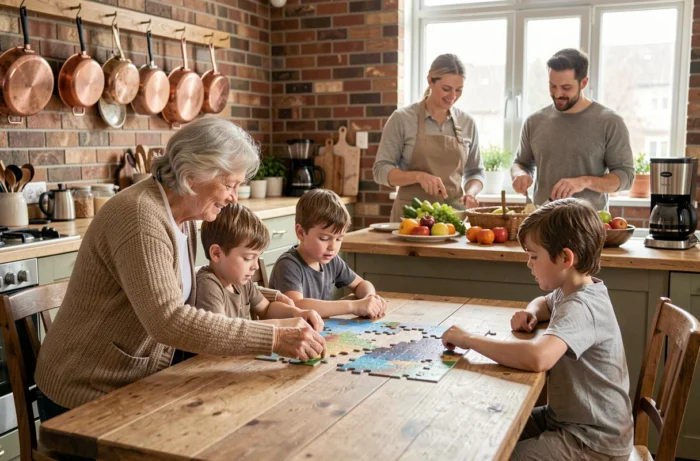
Managing family life day to day isn’t about following a recipe. It means balancing different routines, needs that change as children grow, and practical constraints that organization guides often overlook. Rather than listing best practices, this article explores three concrete factors that can transform family life when properly understood: sharing the mental load, helping children manage their emotions, and the underestimated role of shared meals.
The family mental load: why dividing up chores isn’t enough
Have you ever noticed that even when household chores are shared, one person still has to think of everything? Making medical appointments, planning the grocery shopping, remembering the costume needed for Friday. This invisible work is known as the mental load, and it falls very unevenly on couples.
According to the Drees opinion survey cited by Insee, in 2024, 59% of women said they carried most of this load, compared with 9% of men. Perceptions of whether responsibilities are shared equally also differ by gender: many men believe the division is fair, while their partners disagree.
So the real issue isn’t splitting chores into two columns. It’s transferring the planning itself. In practice, that means assigning entire areas of responsibility—extracurricular activities, laundry, holiday planning—to one person from start to finish, without the other having to remind or check in.
Transferring full responsibility, rather than just occasional tasks, reduces friction far more effectively than a chore chart on the fridge. Useful resources for exploring these topics are regularly published in the family section of Secrets d’Hommes, including articles on fathers’ role in managing the household.

Children’s emotions: put them into words to defuse them
A child who hits, screams, or throws themselves on the floor isn’t throwing a tantrum for no reason. They’re expressing an emotion they don’t yet know how to identify. At three or four years old, it’s not easy to tell the difference between frustration, anger, and sadness.
Put feelings into words before looking for solutions
The classic parental instinct is to solve the problem: offer a replacement toy, promise a reward, or set a boundary. But before trying to fix anything, helping your child name what they’re feeling can change the whole dynamic.
Here’s a simple example: instead of saying, “Stop crying,” try, “You’re angry because your brother took your book.” The child feels understood. Their brain shifts from alert mode to listening mode. Often, the conflict subsides on its own, without punishment or negotiation.
The problem with a limited emotional vocabulary
Many families rely on just three words: happy, sad, and angry. Expanding a child’s emotional vocabulary can make a real difference. A child who can say “I’m disappointed” or “I feel left out” has a tool that can replace shouting or acting out.
- Offer an emotions picture book suitable from age two, with expressive faces the child can point to when they can’t find the words
- Use everyday situations as learning opportunities: “See, the cartoon character is frustrated, not angry”
- Name your own emotions in front of your child: “I’m tired, and it’s making me impatient,” to show that adults experience these feelings too
Children who can name their emotions handle conflict better, at home and at school. It’s not an optional extra; it’s a foundation.
Family meals: a ritual that does much more than nourish
Why focus on meals rather than sleep or screen time? Because a shared meal is the one time the whole family sits down together, face to face, with no other goal than spending time together. Yet this moment is disappearing from many households, often without anyone realizing what’s being lost.

Mealtimes as a chance to talk
Sharing dinner, even a quick one, creates space for everyone to talk about their day. For children, it’s often the only time an adult listens to them without doing something else at the same time. Fifteen minutes sharing a meal is worth more than an hour doing separate things side by side.
This ritual works even better when it’s simple. There’s no need for an elaborate meal or a perfectly set table. What matters is making it a regular habit and giving one another your attention.
Get children involved in meal preparation
Giving a child an age-appropriate task—washing vegetables, setting the table, choosing dessert—has two practical benefits:
- Children build independence through everyday tasks, reducing their reliance on a parent for every little thing
- Mealtime becomes a shared project rather than a service provided by adults, making children less reluctant to come to the table
- Parents save a few minutes of preparation time, which lightens the evening mental load in a tangible way
Just be careful not to turn every meal into a learning activity. Some evenings, a reheated meal eaten together in peace does the job perfectly well.
Family life and real-world constraints: keep it realistic
Advice on organizing family life often assumes two parents are available, the home is spacious, and work schedules are compatible. The reality for many families is different. Single-parent families, in particular, face a higher risk of poverty, and Insee has found that this risk increases with the number of children.
Adapting routines to what your household can realistically manage is the first condition for making them last. An evening ritual that requires an hour of free time won’t work for a parent who gets home at 8 p.m. A five-minute activity—reading a page or sharing a memory from the day—is better than an ambitious plan abandoned after a week.
Family life rarely improves through major changes. It gets better through small, repeated adjustments, chosen to address what’s actually difficult in your home—not your neighbor’s.