
Between 50 and 90 beats per minute at rest: that’s the range commonly cited for adults. But at age 70, this general guideline can mask significant differences depending on physical activity levels, medication use, or underlying heart conditions. Measuring your resting heart rate is straightforward. Interpreting it correctly—especially when a smartwatch alerts you to an irregular pulse—requires a few reliable guidelines.
Resting heart rate at age 70: figures by profile
Resting heart rate varies from person to person, even within the same age group. Several factors account for these differences: fitness level, medications (beta blockers, antiarrhythmics), body mass index, and chronic stress levels.
| Profile at age 70 | Resting heart rate (bpm) | Interpretation |
|---|---|---|
| Active person, regular endurance exercise | Lower end of the range (around 50-60) | Efficient heart, good stroke volume |
| Moderately active person | 60-75 | Typical range, routine monitoring |
| Sedentary or overweight person | 75-90 | Higher reading, associated with increased cardiovascular risk |
| Taking beta blockers | Variable, often < 65 | Medication-induced slowing, which should be distinguished from a well-trained heart |
Epidemiological data show a link between a high resting heart rate and mortality risk. A French Inserm study that followed more than 4,000 men for over 20 years confirmed that a low resting pulse helps reduce the risk of mortality.
To determine the ideal heart rate at age 70, you therefore need to consider the reading alongside the patient’s medical history and lifestyle.
Irregular pulse alert on a smartwatch: what to do before you worry
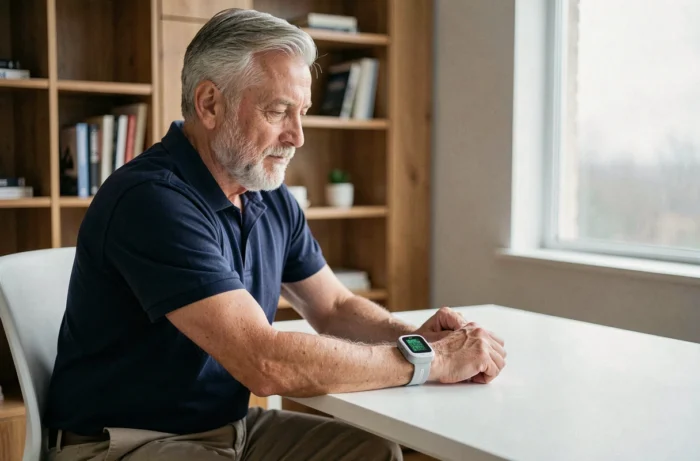
Smartwatches and fitness trackers measure your pulse using photoplethysmography (PPG), an optical signal detected at the wrist. The sensor detects changes in blood flow and can flag an irregular rhythm. At age 70, this type of alert is common, and it can be tempting to conclude that you have atrial fibrillation.
The 2024 European guidelines are clear on this point: a PPG signal alone is not enough to diagnose atrial fibrillation. An ECG interpreted by a healthcare professional is still needed to make a diagnosis. An alert alone is not a reason to start anticoagulant treatment.
What to do after a smartwatch alert
- Do not change any current medication based solely on the notification. The alert is a screening signal, not a medical diagnosis.
- See your primary care doctor or cardiologist for a confirmatory ECG. In some cases, a 24- to 48-hour Holter monitor may be recommended to capture an intermittent episode.
- Keep your smartwatch readings (screenshots and app history): they can help your healthcare provider assess how often the detected episodes occur and how long they last.
- Bear in mind that common factors such as caffeine, a poorly positioned wristband, or wrist movement can trigger false alerts.
A screening trial using ECG patches in people aged 70 and older found no reduction in strokes compared with usual care. However, the trial was stopped early during the COVID-19 pandemic, which limits the scope of its conclusions.
Major smartwatch studies have mostly recruited younger users. Their findings cannot automatically be applied to a 70-year-old, whose heart health, medications, and comorbidities may differ considerably.
Physical activity after 70: more than just endurance for heart health
Endurance exercise (brisk walking, cycling, swimming) remains the go-to way to lower your resting heart rate over the long term. Regular exercise increases stroke volume: the heart pumps more blood with each beat, reducing the number of beats needed per minute.
From age 65 onward, WHO recommendations go beyond endurance alone. They advise multicomponent physical activity that includes functional balance and muscle-strengthening exercises, at moderate or greater intensity, at least three days a week. This type of program reduces the risk of falls and helps preserve independence—two priorities that matter just as much as heart rate to the overall health of someone in their seventies.

Factors that affect resting pulse apart from exercise
Physical activity is not the only factor. Several other things directly affect resting heart rate:
- Chronic stress and lack of sleep can keep your pulse elevated. Slow-breathing techniques (heart coherence, diaphragmatic breathing) have an immediate effect, but their long-term impact depends on how regularly you practice them.
- Caffeine, alcohol, and tobacco speed up your heart rate. Cutting back can have a measurable effect within a few weeks.
- Some medications (bronchodilators, nasal decongestants, thyroid hormones) can increase heart rate as a side effect. A review with your primary care doctor may sometimes allow for an adjustment.
Only regular endurance training and managing stress factors can produce a lasting reduction in resting pulse. Occasional posture or breathing techniques can slow your heart in the moment, but do not change your baseline reading.
High heart rate and cardiovascular risk: what the data show
A resting pulse in the upper part of the normal range (above 75 bpm in an adult) is considered an independent cardiovascular risk factor. This means that even without high blood pressure, high cholesterol, or diabetes, an elevated heart rate is still associated with an increased risk of heart complications.
This link between a high pulse and mortality has been observed in both men and women. It also applies to people whose BMI falls outside the normal range: studies show that people who are overweight or underweight have a significantly higher resting heart rate than those with a normal BMI.
Tracking your resting heart rate is therefore a simple, free indicator that can be measured without any special equipment. At age 70, taking your pulse regularly in the morning, before getting out of bed, provides a reliable reading. A gradual increase over several weeks warrants a medical consultation, even if you have no noticeable symptoms. The heart can send warning signs long before fatigue or shortness of breath sets in.