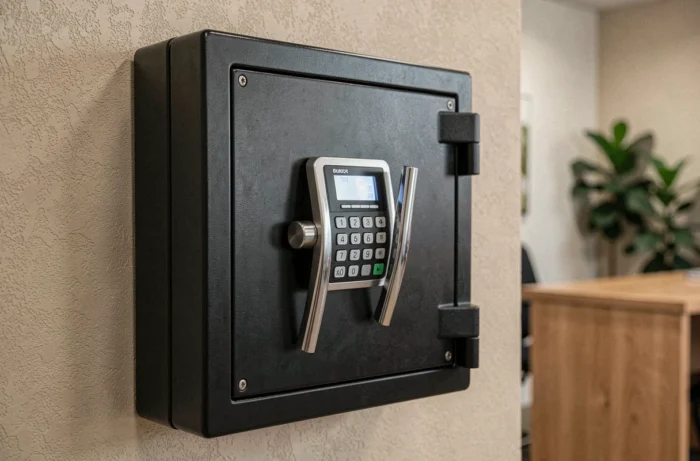
Choosing a safe for a business means weighing several factors that aren’t all apparent from a product sheet. Burglary-resistance class, lock type, fire-resistance standard, installation method: these criteria don’t always overlap. Two safes with the same class rating can offer very different levels of protection, depending on the standard applied.
EN 1143-1 and EN 14450 standards: tests that measure different things
The most common approach is to compare security classes without checking which standard governs them. Safes certified to EN 1143-1 are divided into classes ranging from 0 to XIII, each representing an increasing level of resistance to burglary.
Security cabinets fall under a different standard, EN 14450, which provides for only two levels: S1 and S2. To get a clearer picture of manufacturers and their product ranges, a comparison of professional safe brands can help.
Comparing an EN 1143-1 Class I safe with an EN 14450 S2 security cabinet makes no sense: the attack durations, tools and methods used in testing differ from one standard to another. An S2 cabinet is suitable for protecting everyday documents, but not cash or valuables that require a Class I safe or higher.
The rarely highlighted T2 designation distinguishes safes in the same class. A model certified with the T2 option has undergone additional tests to assess its resistance to cutting tools. This detail, listed on the certificate, can explain the price difference between two models that are otherwise very similar.
Five leading professional safe brands: a data comparison
| Brand | Origin | Main standard | Primary market segment | Lock type |
|---|---|---|---|---|
| Fichet-Bauche | France | EN 1143-1 | Institutional, banking, business | Key, electronic, connected |
| Hartmann Tresore | Germany | EN 1143-1 | SMEs, professional practices | Key, electronic |
| Burg-Wächter | Germany | EN 1143-1, EN 14450 | Retail, mixed use | Electronic, biometric |
| Chubbsafes | United Kingdom | EN 1143-1, EN 1047-1 | Business, fire-resistant archiving | Key, electronic |
| Technomax | Italy | EN 1143-1, EN 14450 | Hospitality, retail | Electronic |
The differences in standards coverage are the first thing this table reveals. Fichet-Bauche and Hartmann Tresore focus exclusively on EN 1143-1. Burg-Wächter and Technomax also offer EN 14450-certified ranges, extending their product selection to mixed-use applications and more modest budgets.
Choosing a brand therefore depends less on a quality ranking than on how well its certified standard matches the actual value of the items to be protected.
Fire resistance and burglary-resistance class: two certifications to assess separately
A Class III safe withstands burglary attempts in accordance with EN 1143-1 testing. This says nothing about how its contents will fare in a fire. Fire protection is covered by separate certifications: EN 15659 for paper documents and EN 1047-1 for digital media (hard drives, backup tapes).
A safe suitable for cash is not automatically suitable for storing sensitive documents. This is a common misconception.
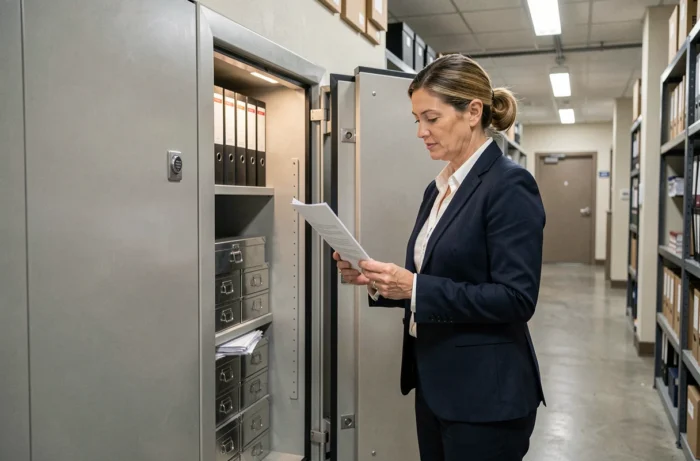
A medical practice or notary’s office, where cash and confidential files are kept together, often needs both burglary-resistance and fire-resistance certification. Fichet-Bauche offers fire-resistant solutions, but focuses this range on its banking and institutional products. Before purchasing, it is essential to check the fire-resistance certificate for the specific model under consideration.
Installation and insurance requirements: a criterion rarely listed
How a safe is installed can determine whether an insurer will cover it. An unanchored safe, or one that is improperly anchored, may result in a claim being denied even if its burglary-resistance class is high. Insurance policies generally require:
- Anchoring to the floor or wall in accordance with the manufacturer’s instructions, using fixings suited to the surface (solid concrete, concrete block, slab)
- A burglary-resistance class appropriate to the declared value of the items being protected (the minimum threshold varies by policy)
- Written documentation specifying the class, installation location and anchoring method, to be submitted before the policy is taken out or renewed
For brands whose product ranges target the broader European market, such as Technomax, check that the supplied anchoring kit meets the specific requirements of the French insurance policy.
Electronic locks and access management in the workplace
Beyond the safe’s physical resistance, access management is a key comparison criterion in its own right. In a shop or hotel, several employees may need to open the safe, sometimes during specific time windows or with different authorization levels.
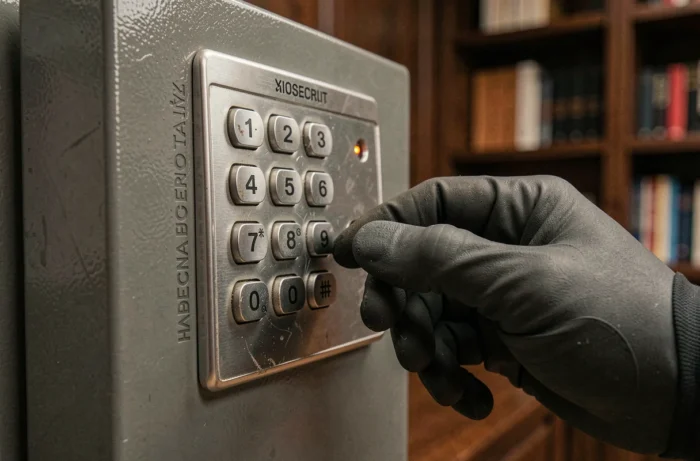
Electronic locks with multiple codes assign each user a unique code, making every opening traceable. Several manufacturers offer this feature, with connectivity options varying by product range.
EN 1300 classifies locks according to their own resistance, independently of the safe’s certification. A high-class safe fitted with a non-certified lock has an exploitable weak point. These two certifications should be checked separately on the model’s certificate.
For businesses that handle daily cash deposits, some models include a deposit slot that restricts access to the contents to holders of the master code or main key.
The choice between these five brands rarely comes down to sheer resistance, which is already defined by the burglary-resistance class. Fire certification, an anchoring method accepted by the insurer, and precise access management are what make a practical difference. Having the insurer confirm its requirements in writing before purchase remains the most cost-effective precaution.