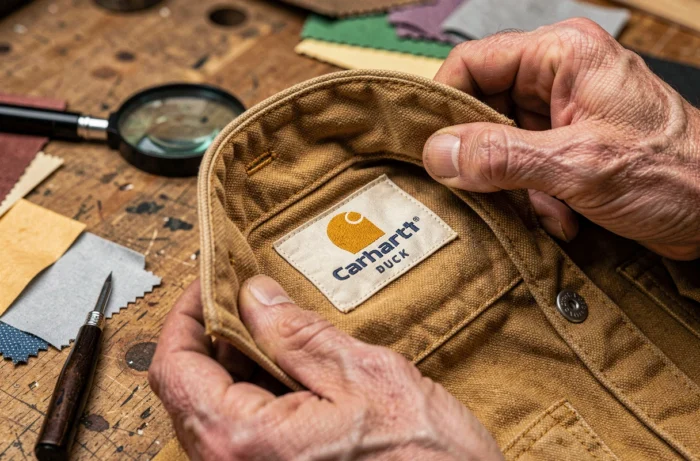
A Carhartt beanie bought online with a label that looks slightly different from a friend’s, or a thrifted Detroit jacket with an unusual fit: situations like these can raise immediate doubts. Telling a genuine Carhartt from a counterfeit means knowing where to look—and remembering that not all authentic Carhartt pieces look alike.
The American brand and its European line, Carhartt WIP, launched in 1997, use different labels, fits and finishes. A detail that seems suspicious on one line may be perfectly normal on the other.
Carhartt or Carhartt WIP: identify the line before judging the item
Before inspecting a seam or logo, ask yourself one simple question: is this item from Carhartt (American workwear) or Carhartt WIP (the European fashion line)? The two brands share a name, but their labels, product codes and finishes differ.
On a Carhartt WIP item, you’ll find a detailed alphanumeric product code (for example, I037678.00E.PG.03 for a sweatshirt) that combines the model reference, color and size. This code lets you find the exact product listing at an authorized retailer and check that the details match. Carhartt workwear uses a different product-coding system, often with shorter codes and a category-related prefix (J for jacket, K for knitwear).
Confusing the two lines is the most common mistake when checking an item. Someone trying to compare a genuine Carhartt with a fake using a WIP guide while holding a workwear jacket may wrongly conclude that they have a counterfeit. Identifying the line is therefore the first step in any assessment.
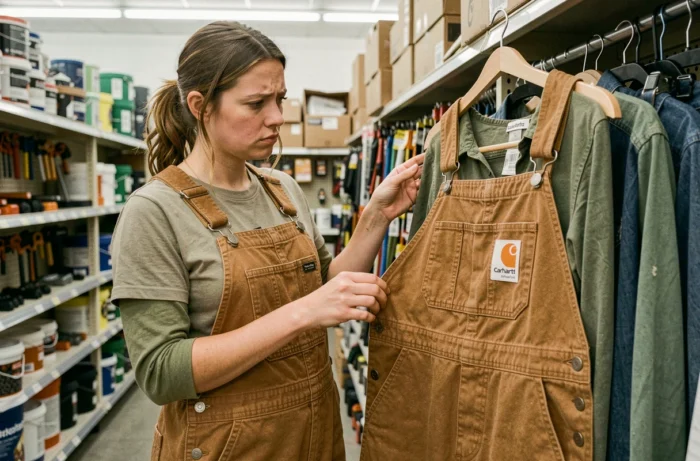
Vintage Carhartt pieces and collaborations: when the usual checks no longer apply
General authentication guides describe the features of recent, standard production. They become less reliable as soon as you look beyond that scope.
Vintage models and changes in manufacturing
Carhartt has changed its labels, production locations and zipper suppliers over the decades. A jacket made in the United States in the 1990s won’t have the same care label or typography as a current model made in Asia. A different label does not automatically mean an item is counterfeit.
For an older piece, the best approach is to look for photos of the same model from the same period on specialist forums or in collectors’ archives. Reddit discussions on r/Carhartt are full of dated visual comparisons that can help place a label in its historical context.
Collaborations and special editions
Carhartt WIP has released numerous collaborations (with Nike, Patta and other brands). These pieces often feature modified logos, exclusive colors or unusual finishes. A detail that seems out of place on a classic model may be perfectly legitimate on a collaborative edition. Before deciding it’s fake, check whether the model belongs to an identifiable collection by consulting the official Carhartt WIP journal or product listings from authorized retailers.
Checking Carhartt through physical details: seams, labels and hardware
Once you’ve identified the line and period, a physical inspection becomes much more useful. Three areas deserve particular attention.
- Seams and stitch density: On an authentic Carhartt item, the stitching is even and tight, with a consistent number of stitches per centimeter, including around curves. Counterfeits often have visible irregularities, skipped stitches or threads sitting loose on the surface instead of being embedded in the fabric.
- Main label and care label: The logo lettering embroidered on the main label should be crisp, with clean edges on every letter. The print on care labels should normally withstand several machine-wash cycles. Ink that runs or text that blurs after a single wash is a warning sign.
- Zippers and buttons: Carhartt uses zippers from reputable suppliers, with deep, legible engraving on the pull tab. Buttons are generally marked on the back. A smooth pull tab with no inscription, or a button whose raised detail wears away when touched, should raise concerns.
The fabric feel test
Carhartt workwear canvas is heavy enough to hold its shape when laid on a flat surface. Fabric that feels soft or thin on a model that is supposed to be made from heavyweight canvas is a strong warning sign. This test remains reliable even for older pieces, as Carhartt canvas retains its stiffness through years of wear.
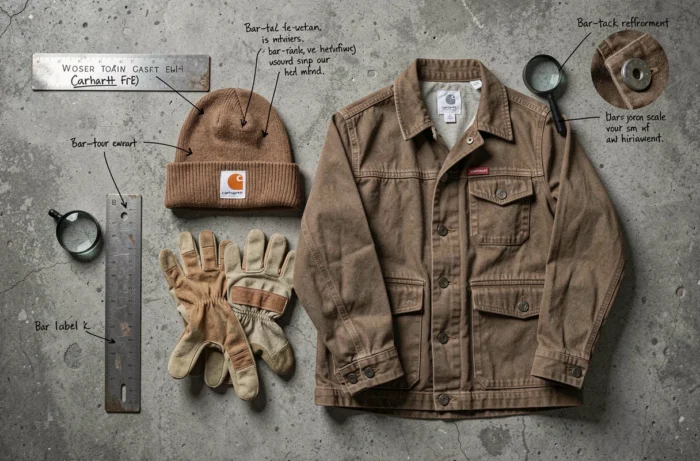
Checking the Carhartt product code: an often-overlooked additional check
Beyond visual inspection, the product code on the inside label offers a practical way to cross-check an item. For Carhartt WIP pieces, this code follows a standardized format that encodes the model, color and size.
Have you ever noticed this code on the label without knowing what it was for? Enter it on the official website or an authorized retailer’s product page to check that the model, color and size match the item in your hands. If the code doesn’t lead to an existing listing, or the details don’t match, the item deserves closer inspection.
The process is similar for Carhartt workwear: the style number (often preceded by a letter) appears in the brand’s catalog. Counterfeiters rarely reproduce a consistent product code, as doing so requires knowing the exact coding system for each season.
The European Ecodesign for Sustainable Products Regulation (ESPR, Regulation (EU) 2024/1781) will eventually provide for digital product passports by product category, but these requirements have not yet been defined for clothing. For now, the product code remains the best traceability tool available to consumers.
No single method guarantees a reliable verdict. Combining line identification, physical inspection and a product-code cross-check provides the most thorough assessment. With a vintage or collaborative piece, allowing for the possibility that an unusual detail is legitimate can help you avoid dismissing an authentic item out of excessive caution.