
A domestic rodent refers, in common terms, to a small herbivorous or omnivorous mammal kept in captivity: hamster, guinea pig, rat, gerbil, chinchilla, or even rabbit (which actually belongs to the order of lagomorphs, but shares the same adoption pathways). Welcoming one of these animals means preparing an environment suitable for its physiology before its arrival, not after.
The most common mistakes occur in the first few days when the animal experiences stress from transport and change of territory.
Legal status and formalities according to the species of rodent
The term “rodent” is not enough to determine administrative obligations. In France, some species are considered domestic, while others fall under the regulations for non-domestic animals, with specific holding conditions. Checking the exact name of the species before adoption avoids unpleasant surprises.
The commitment certificate and the legal reflection period of at least seven days apply specifically to the acquisition of a pet rabbit, but not automatically to hamsters, guinea pigs, or domestic rats. Inquire with the breeder or pet store about the procedures corresponding to your species.
Regarding identification, dogs, cats, and ferrets are subject to it before any transfer. For rabbits, guinea pigs, and chinchillas, identification is generally not mandatory in France, unless you plan to travel abroad with the animal. A good resource to explore different species and their needs remains le-petit-castor.fr, which details the specifics of each small companion.
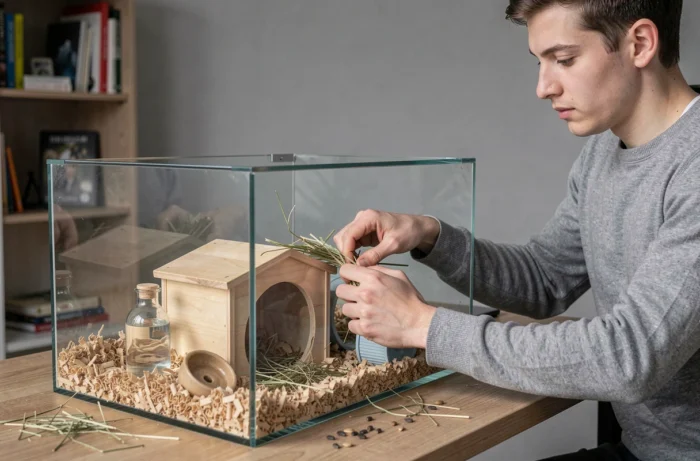
Habitat and cage: dimensions suitable for each rodent
The cage constitutes the main territory of the animal. Its size directly depends on the locomotor behavior of the species. A chinchilla or a rat, which climbs and jumps, needs a tall cage with platforms. A guinea pig, a terrestrial animal, requires a wide floor space rather than vertical volume.
Criteria for choosing the cage
- The spacing of the bars must prevent any escape: closely spaced and horizontal bars are suitable for mice and gerbils, which cling to them to climb.
- The bottom tray must be deep enough to contain the bedding without it being thrown outside with every movement.
- The opening must allow for handling the animal and cleaning the habitat without disassembling the entire structure.
- The location in the house is as important as the cage itself: away from drafts, direct sunlight, and noise sources (television, speakers, frequent passages).
Preparing the cage, bedding, and accessories before the adoption day allows the animal to be placed directly in a ready space. Every hour spent in a transport box increases the stress of the move.
Specific diet: why a “all rodents” menu poses a problem
Nutrition needs vary greatly from one species to another. A guinea pig does not synthesize vitamin C: its diet must contain it daily, in the form of fresh vegetables or supplements. An omnivorous hamster tolerates small amounts of animal protein (dried mealworms). A generic “all rodents” food never covers these specificities.
Hay forms the dietary basis for rabbits, guinea pigs, and chinchillas. It ensures continuous dental wear, a critical point for these species whose teeth grow throughout their lives. A lack of hay leads to dental malocclusions that require veterinary intervention.
For granivorous species (hamster, gerbil), seed mixes must be supplemented with small amounts of fresh vegetables. Monitor the leftovers in the bowl: some rodents sort out the fattier seeds and leave the rest, which disrupts their ration.
Co-habitation and sociability of the rodent at home
The guinea pig is a social animal. Welcoming a guinea pig alone goes against its social needs and can cause chronic stress, loss of appetite, or even behavioral issues. Two females or a neutered male with a female form stable pairs.
The hamster, on the other hand, is solitary and territorial. Two hamsters in the same cage will eventually fight, sometimes fatally. Sociability is not a trait shared by all rodents: it varies from species to species.
Introducing the rodent to other animals
If a cat or dog already lives in the household, the cage must be inaccessible and placed in a room where the pet cannot enter freely during the first weeks. A cat remains a predator, even when domesticated. Supervised, brief, and gradual introductions do not guarantee safe cohabitation: the cage must always be locked and stable, even once the routine is established.

First days: managing stress and handling
Upon arrival, the rodent explores its new habitat cautiously. Avoid handling it during the first two or three days. Speak to it softly, approach your hand to the entrance of the cage without grabbing it, and let it come to you. Forcing it to come out reinforces its flight reflex.
A often overlooked point: the activity cycle. The hamster is nocturnal. Waking it during the day to play with it disrupts its biological rhythm and generates irritability, even bites. The guinea pig and rabbit, more crepuscular, are more receptive in the early morning and late afternoon.
- Never lift a rodent by the tail (risk of skin degloving in certain species like the gerbil).
- Place one hand under the thorax and the other under the hindquarters for secure handling.
- Children should sit on the floor during handling to limit the height of a fall in case of sudden movement.
Complete adaptation generally takes one to two weeks. An animal that eats normally, explores its cage, and accepts contact without fleeing has found its bearings. The greatest service you can provide at this stage is to respect its pace rather than your own.