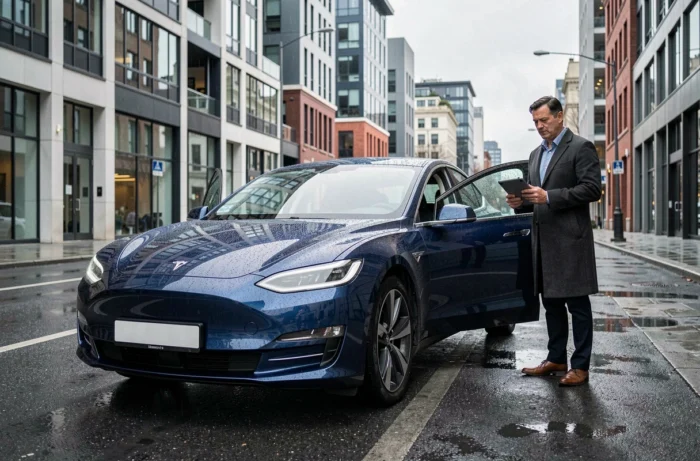
The Euro 7 standard is no longer limited to exhaust emissions. It now covers particles generated by brake wear and tire abrasion, including on electric vehicles. This broader scope redefines what we mean by a “clean vehicle” and requires manufacturers to rethink components long considered secondary to a vehicle’s environmental impact.
Euro 7 and non-exhaust particles: what the standard means for electric vehicles
Brake pads and tires generate fine particles that have so far escaped regulation. Euro 7 addresses this gap by setting limits on these non-exhaust emissions. For electric vehicles, often presented as zero-emission, the requirements are significant: their greater weight due to the batteries increases tire wear and puts more strain on the brakes, despite regenerative braking.
The standard also requires a minimum period of effectiveness for emissions-control systems, prompting suppliers to rethink the service life of their catalytic converters and filters. A vehicle that complies when it leaves the factory will have to remain compliant for much longer than before.
This regulatory framework is opening up new areas for development: low-particle friction materials, low-abrasion tires, and brake-dust capture systems. It is changing the way the automotive sector is monitored, as shown by the analyses available in Officiel News’ automotive section, which regularly covers these regulatory developments.
Low-emission zones in France: local timelines complicate the used-car market
Low-emission zones remain in force in France’s major urban areas. However, how they are applied varies from one local authority to another: some cities are extending their awareness-raising periods, while others are considering tightening restrictions as early as 2027.
This inconsistency has a direct impact on the automotive market. A Crit’Air 3 vehicle may be allowed to circulate freely in one city but barred from a neighboring one. For used-car buyers, resale value now depends as much on the Crit’Air rating as on mileage.
Social equity and fleet renewal
Fleet renewal raises questions about access to mobility. Lower-income households often drive older models that are directly affected by the restrictions. Replacing an aging combustion-engine vehicle with a recent electric or hybrid model is an investment that current subsidies do not always cover.
Vehicle inspections are evolving in the same direction. They are increasingly targeting vehicles that pollute because of poor maintenance, not just because of their age or powertrain. A well-maintained vehicle can pollute less than a newer, poorly maintained model, challenging approaches based solely on the year a vehicle was first registered.
Batteries and software architecture: two technical fronts to watch
Solid-state batteries are attracting significant investment. They promise higher energy density, shorter charging times, and improved thermal stability. Several manufacturers have announced plans for initial production models in the near future, but scaling up production remains the real industrial challenge.
At the same time, the concept of the software-defined vehicle is changing the relationship between drivers and their cars. Over-the-air updates can add features, adjust vehicle dynamics, or optimize energy management without a trip to the workshop. They are also changing the business model: some features are becoming paid services that can be activated remotely.
Onboard artificial intelligence and driver assistance
Driver-assistance systems are advancing in stages. Level 3 autonomous driving, in which the vehicle handles certain situations without driver intervention, is beginning to receive highway approvals in several European countries. Progress to Level 4 remains dependent on unresolved questions of legal liability.
Onboard artificial intelligence is not limited to driving. It can manage cabin temperature, optimize routes based on battery charge, and predict potential faults. These functions rely on computing chips whose power consumption must remain compatible with the vehicle’s range.
- Solid-state batteries: higher energy density, but large-scale industrialization is still underway
- Over-the-air software updates: new features without a workshop visit, but questions remain about the long-term availability of services
- Onboard AI: predictive maintenance and energy optimization beyond basic driver assistance
- Level 3 autonomous driving: approvals underway, while the legal framework for Level 4 remains to be defined

Tires and vehicle maintenance: overlooked factors in the green transition
Tires are a blind spot in the transition. Their composition, wear, and recycling are subject to new requirements under Euro 7. Manufacturers are developing low-abrasion rubber compounds to reduce the microparticles released onto roads.
Tire choice directly affects an electric vehicle’s energy consumption. Low-rolling-resistance tires can add several dozen kilometers of range over a full driving cycle. Conversely, a tire that is not suited to the vehicle’s weight wears faster and compromises road handling.
Regular maintenance—tire pressure, wheel alignment, and brake-pad condition—has a measurable environmental impact. Enhanced vehicle inspections use these criteria to assess a vehicle’s actual impact, regardless of its powertrain. Maintenance is becoming an environmental criterion in its own right, not just a matter of safety.
The trends shaping the roads of tomorrow are not limited to electrification and autonomous driving. Regulations on non-exhaust particles, local differences in low-emission zones, and changes to vehicle inspections are also reshaping motorists’ everyday lives. Tire choices, onboard software, and maintenance now weigh as heavily as the type of powertrain in a vehicle’s overall environmental impact.